How Much Does It Cost to Install Herringbone Wood Floors? (2026)
Last updated: September 24, 2026
Your herringbone installation cost has two main parts: the flooring you buy and the labour needed to fit the pattern. For a Toronto or GTA project, compare those prices separately, then check preparation, material allowance and finishing details before treating a per-square-foot figure as the full budget.
For 2026 planning in Toronto and the GTA, allow about $4–$8 CAD per sq. ft. for herringbone wood flooring material and $5–$7 CAD per sq. ft. for professional herringbone or chevron installation labour.
Together, that creates a base planning range of approximately $9–$15 CAD per sq. ft. before additional material for cuts and pattern alignment, removal, subfloor work, transitions, baseboards, access requirements and HST. These are approximate 2026 planning figures rather than a fixed estimate. The exact price is confirmed after an on-site assessment of the room, subfloor, layout and required scope.
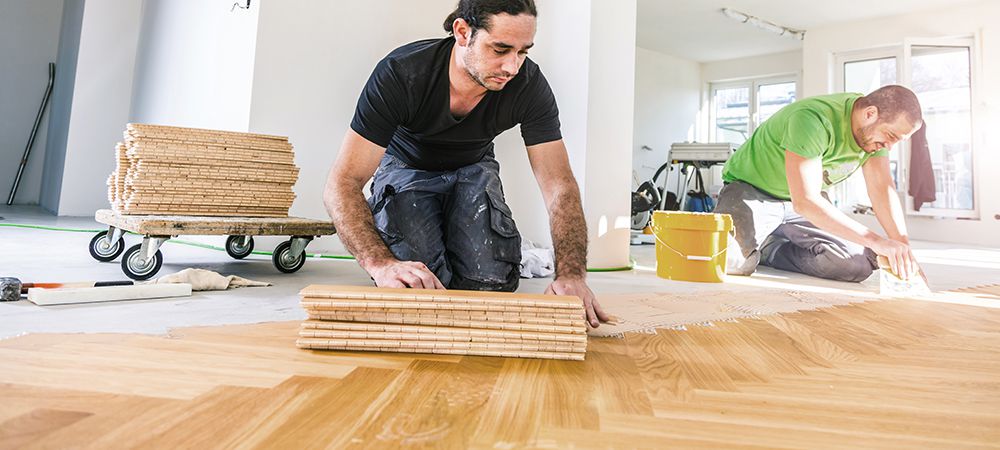
Installing herringbone wood floors is more complex compared to regular hardwood floors. The reason is, unlike traditional hardwood floors, it follows a zigzag detail. Hence, it’s easy to assume that herringbone floors are expensive.
That’s not always the case. Here we’ll provide an in-depth look at the cost of installing herringbone flooring. Here’s what you need to know.
What is the Overall Price of Installing Herringbone Floors?
Start with the selected product price, the measured installation area and the material allowance for the layout. A complete quote can be higher when it includes old-floor removal, disposal, subfloor preparation, borders, transitions, trim, stairs, restricted access or HST. Compare quotes for the same product and layout: the same area, board specification, pattern direction, borders and preparation scope. Check whether adhesive or fasteners, trims, delivery and HST are included, and how additional work would be approved.
Although installing herringbone over an existing floor is not a popular floor installation method, some homeowners prefer it. The general installation labour range applies only when the existing surface is suitable and the scope is straightforward. Any levelling, reinforcement, moisture work or extra preparation is assessed and quoted separately.
Professionals often avoid placing herringbone over an unsuitable existing floor. Removing the old floor and inspecting the substrate makes the required preparation clearer and can prevent hidden levelling, movement or moisture problems from appearing after installation.
For complicated projects, the installation rate can fall outside the general installation range. Upgrades such as changing the subfloor, adding borders or installing another hardwood alongside herringbone are priced after the layout and site conditions are reviewed.
Related Article: What is Herringbone Hardwood Flooring?
How Much Does It Cost To Install 1000 Square Feet Herringbone Flooring?
For 1,000 sq. ft. of measured installation area, the 2026 base labour range is approximately $5,000–$7,000 CAD. If a 15% allowance is added for cuts and pattern alignment, about 1,150 sq. ft. of material would cost approximately $4,600–$9,200 CAD at the general $4–$8 material range. That creates a base planning subtotal of roughly $9,600–$16,200 CAD before removal, preparation, trim, delivery, access requirements and HST.
The measured floor area determines the starting quantities, but the material order and installed area are different. Buy the confirmed allowance for cuts and pattern alignment, rounded up to full cartons; calculate installation labour on the measured area unless the quote specifies another basis.
For a 2,000 sq. ft. area, calculate the material purchase quantity and installation labour separately, then add the project-specific cost of removal, preparation and finishing details. Rooms with simple shapes are easier to measure than areas with many angles or connected spaces. To estimate the square footage of a rectangular room, multiply its width by its length.
Premium species, custom borders, difficult layouts and extensive preparation can take a project beyond the base material-and-labour budget. Those upgrades should be listed separately in the written estimate rather than hidden in one headline rate.
Since flooring companies often quote herringbone flooring by the square foot, the table below shows planning figures for several standard room sizes.
| Measured Area | Approx. Material Quantity With 15% Allowance | 2026 Material Range ($4–$8/sq. ft.) | 2026 Labour Range ($5–$7/sq. ft.) |
|---|---|---|---|
| 100 sq. ft. | 115 sq. ft. | $460–$920 | $500–$700 |
| 150 sq. ft. | 172.5 sq. ft. | $690–$1,380 | $750–$1,050 |
| 200 sq. ft. | 230 sq. ft. | $920–$1,840 | $1,000–$1,400 |
| 300 sq. ft. | 345 sq. ft. | $1,380–$2,760 | $1,500–$2,100 |
| 375 sq. ft. | 431.25 sq. ft. | $1,725–$3,450 | $1,875–$2,625 |
| 500 sq. ft. | 575 sq. ft. | $2,300–$4,600 | $2,500–$3,500 |
| 800 sq. ft. | 920 sq. ft. | $3,680–$7,360 | $4,000–$5,600 |
All table prices are in CAD. Quantities are arithmetic examples; actual orders must be rounded to full cartons. Material allowance varies by layout, and the figures exclude removal, preparation, trim, delivery, access requirements and HST.
Cost of Prep Work
Before you install the herringbone flooring, set aside a budget to cover the cost of initial prep work. How much you spend on prepping depends on the extent of repair. If it’s an old home, you may need to remove the existing floor and subfloor.
Some installers may help move furniture as part of the agreed scope; others price it separately. Many hardwood installations use a suitable plywood subfloor, but the required assembly depends on the product, structure and site conditions. New plywood, levelling or repair is quoted after the existing surface is inspected.
An existing concrete subfloor may be suitable when the chosen product and installation system permit it and its moisture, flatness and condition meet their requirements. Compare the required preparation rather than assuming concrete is automatically the cheaper option. Also check baseboards, thresholds, transitions and door clearances.
Standard existing-floor removal generally ranges from $1–$2 CAD per sq. ft. Levelling, when needed, has a general planning range of $1–$3 CAD per sq. ft.; structural repairs and new plywood require a separate assessment. See our guide to flooring removal and replacement costs in Toronto for the demolition and preparation budget.
After installation, you may require cleanup and disposal. Confirm whether carrying, hauling and disposal are included in the contractor’s scope or priced separately.
Labour Costs for Installing Herringbone Wood Flooring
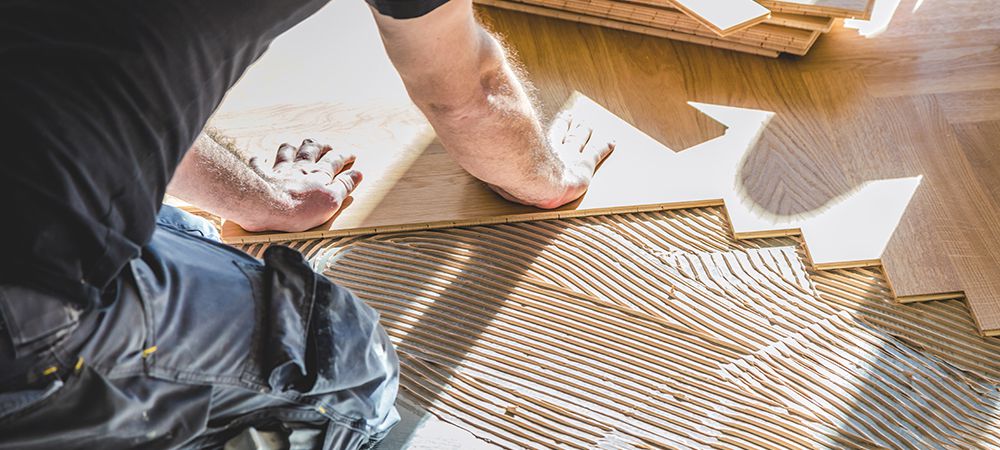
For 2026 planning, professional herringbone or chevron installation labour generally ranges from $5–$7 CAD per sq. ft. More difficult layouts, borders, stairs or unusual site conditions are quoted separately. Some trades price by the hour, but their current rate and exact scope should be confirmed in writing for the project.
Typically, it takes between 2 to 5 days for an installation team consisting of two or three people to install herringbone flooring of 1000 square feet. If the floor size is larger, it may take weeks.
The price of an installation crew depends on the team size, schedule and scope. Although one installer may appear cheaper, an appropriately sized team can complete larger or time-sensitive projects more efficiently.
Other than professional installers, you’ll also require the service of several labourers. In fact, you may need to hire a contractor to supervise the project. In every installation process, labour takes up to 60% of the cost.
Listed below are the labourers you’ll need for a smooth herringbone flooring project:
Floor joist repairs
If there’s extensive rot, insect damage or moisture on your floor, you may need to reinforce the joists. Structural repair is outside the standard herringbone installation range and must be assessed and quoted for the specific condition. The flooring installer can identify a concern, but structural work may require an appropriate specialist.
Plumber
If you’re renovating a kitchen, basement, bathroom or another area affected by plumbing, you may need a plumber. Plumbing is not included in the general flooring rate and should be quoted separately by the trade, helping avoid costs associated with leaks or improper alterations.
Professional contractor
Hiring a separate professional contractor may not be necessary if the flooring company manages the agreed scope. When separate project management is required, its fee should be identified in the quote instead of assumed as a fixed percentage of the flooring price.
Architect
In Canada, homeowners can choose from several herringbone flooring designs. With the help of an architect or designer, you can plan a layout to suit the space. For complicated designs or structural changes, specialist services are quoted separately at the professional’s current rate.
Carpenter
Carpentry can affect the cost of installing herringbone flooring when custom cutting, borders or other detailed woodwork is required. Many products are supplied as pre-cut herringbone planks, while custom details may need additional cutting. Any separate carpentry work should be itemized at the trade’s current rate.
Cost of Herringbone Wood Floor: Type of Wood
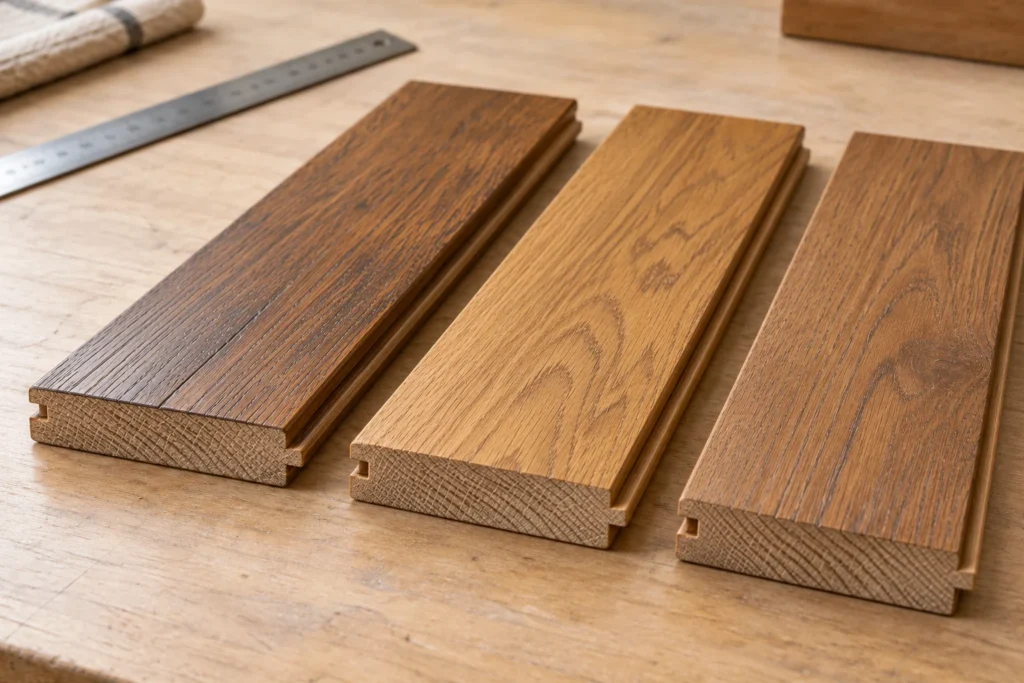
You can install high-quality herringbone flooring with many species of wood. These products are available in solid and engineered construction. For 2026 planning, material generally ranges from $4–$8 CAD per sq. ft., but the exact product price depends on species, grade, dimensions, construction, finish and current supplier availability.
Whatever type of wood you choose, it can give your home an elegant and timeless style. The table below keeps the original species comparison and identifies details to specify when requesting a current product price. Availability must be confirmed for each product.
| Wood | What to specify in the product quote |
|---|---|
| Maple | Specify grade, board dimensions and factory finish. |
| Sapele | Confirm herringbone-format availability, construction and delivery cost. |
| Red oak | Compare the same grade, dimensions and finish across quotes. |
| Walnut | Confirm grade, dimensions and the exact finish included. |
| Hickory/Pecan | Confirm the named species, grade and herringbone product format. |
| White oak | Specify grade, width, construction and finish for the comparison. |
| Teak | Confirm the exact species, product availability and delivered quantity. |
| Mahogany | Confirm the exact species sold under the product name and its construction. |
| Pine | Confirm product suitability for the room, dimensions and finishing scope. |
The $4–$8 CAD per sq. ft. material range is a general planning range, not a promise that every species or grade will fall within it. Use the current product quote for the final comparison.
Factors that Affect the Cost of Installing Herringbone Hardwood Flooring
Several factors determine the final cost to install herringbone flooring in Canada. Thanks to the following mitigating factors, it’s unlikely you’ll find a definite price for laying herringbone.
Location in your home
If your space has multiple tight angles, small spaces and closets, it’ll increase the cost of installation because it makes the work more difficult. For example, if you’re flooring your staircase, you may have to pay more for installation.
Type of wood
Hardwood floors come in different species, finishes and styles. Domestic hardwood species are less expensive to use for herringbone floors. On the other hand, exotic hardwoods are on the high side because of their scarcity. Not to mention, the price of transporting them increases the overall installation fee.
Unfinished hardwood may have a lower initial product price, but it requires sanding and finishing on site. That extra work is not included in the general herringbone installation range and should be quoted separately.
Prefinished floors can have a higher product price but require less finishing work after installation. Compare the complete scope—product, installation and finishing—rather than choosing from the material price alone.
Kind of finishing
The surface finish material also affects the cost of herringbone flooring. Site sanding, staining and finishing are priced separately because the scope depends on the product, condition and desired system. Hardwood finishes help protect against wear, moisture and scratches. Common systems include lacquer, wax, acrylic and oil-based products.
Because herringbone has many joints and a detailed pattern, site finishing can require additional care. The exact amount should be confirmed after the installer reviews the floor and the specified finish.
Handscraped floors cost more than polished floors, as they are more labour-intensive to create.
The material, labour and finishing scope together determine whether a herringbone project falls near the lower or higher end of the budget. For general 2026 planning, sanding, staining and refinishing are approximately $3–$5 CAD per sq. ft. The exact finish system, repairs and any additional work must be specified in the quote. The table below explains what to compare; these categories can overlap.
| Kind of finish | What the quote should specify |
|---|---|
| Oil finish | Specify the product, number of coats and maintenance instructions. |
| Surface finish | Confirm the named system, preparation and coats included. |
| Polyurethane | Identify the product, sheen, coats and cure-time instructions. |
| Penetrating finish | Confirm product compatibility, application steps and maintenance. |
| Unfinished hardwood | Product plus site-finishing quote |
| Factory finish | Included in the current product quote |
Thickness
Thickness and the usable wear layer affect the product price. Thicker solid boards or engineered products with a substantial wear layer may support more future refinishing, but the current product specification and supplier quote—not a generic thickness price—should guide the comparison.
Engineered and solid hardwood
Engineered herringbone pricing depends on wood species, grade, dimensions, wear layer and finish. Its layered construction can offer better dimensional stability than solid wood in many installations, including projects over suitable concrete slabs.
Homeowners may find engineered hardwood budget-friendly, but solid and engineered products should both be compared using the current product quote. Premium or specialty products can fall outside the general material range shown above.
It’s very excellent for laying exotic woods like heart pine, acacia and Brazilian cherry. One significant benefit of installing solid wood planks is that you can refinish and sand them many times.
Pattern and style
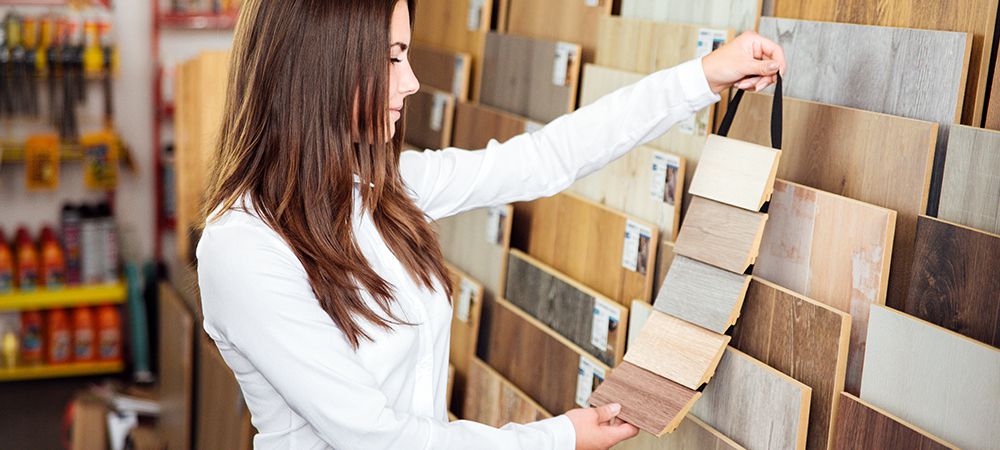
The patterns and styles available for herringbone flooring also affect the cost. Product pricing should be confirmed from the current selection, and custom layout work should be listed separately from standard installation. Unlike regular straight-laid hardwood, herringbone requires the blocks to be aligned in a repeating zigzag pattern.
The herringbone installation process takes more time and precision than a straight-plank layout. Borders, diagonal orientation, narrow hallways and connected rooms can increase labour beyond the general range and should be itemized in the quote.
How To Estimate The Cost Of Installing Herringbone Hardwood Flooring
Calculating the cost of installing herringbone flooring per square foot is relatively easy. It only requires simple maths.
Use these steps to build an approximate budget for your space. The final quote follows an on-site assessment:
- Multiply each room’s length by its width, then add the areas to find the measured installation area.
- Add the material allowance for cuts and pattern alignment. A 15% allowance is used in the examples here; confirm the final quantity for the product and layout.
- Multiply the purchase quantity by the material price per sq. ft.
- Multiply the measured installation area by the labour rate. Do not charge the material waste allowance as additional installed floor area.
- Add any removal, preparation, adhesive, transitions, baseboards, delivery, disposal and applicable HST specified in the estimate.
Budget formula: (material purchase quantity × material price) + (measured installation area × labour rate) + additional scope + applicable HST.
For example, a 500 sq. ft. room with a 15% material allowance requires about 575 sq. ft. of product. At $4–$8 per sq. ft., material is approximately $2,300–$4,600. Labour on the measured 500 sq. ft. at $5–$7 per sq. ft. is approximately $2,500–$3,500, creating a base subtotal of $4,800–$8,100 before project-specific extras and HST.
DIY Cost Of Installing Herringbone Flooring
Herringbone flooring installation is best left to professionals. However, homeowners sometimes consider DIY to reduce labour expense. A responsible DIY budget still includes the current material price, a 10%–15% cutting allowance, adhesive or fasteners, preparation materials, tool rental or purchase, transitions and disposal. Because room sizes and conditions differ, there is no reliable fixed DIY total.
For a DIYer, the herringbone flooring pattern is more intricate and complicated than traditional flooring designs. It goes beyond gluing, nailing or measuring the planks. Any little error in the installation process can make you spend twice the price of hiring a professional.
If you don’t have the necessary tools for installation, add their rental or purchase to the budget. DIY herringbone installation can become expensive when layout errors increase waste or require correction. If you’re considering the DIY route, review the exact engineered or solid product instructions first and make sure the subfloor and installation method are suitable.
Related Article: What’s The Difference Between Chevron And Herringbone Floors?
Herringbone Flooring is Affordable
The cost to install herringbone flooring can be lower or higher depending on room size, product choice, pattern complexity and preparation. A smaller, straightforward project may stay near the lower end of the planning range. Pre-cut planks, a suitable in-stock product and a well-prepared subfloor can help control the budget.
If you’re wondering whether the cost of herringbone flooring is worth it, the answer is yes. It increases the resale value of your home and lends it beauty. Herringbone also has a timeless appeal, which can last for many years without going out of trend. No matter the overall cost, herringbone flooring is an excellent choice for the home.
The best time to install herringbone flooring depends on your renovation schedule, site readiness and product availability. If you’re considering a herringbone floor for a home or commercial space, review our herringbone wood flooring options and contact LV Flooring for a project-specific assessment.
For a home in North York, see our North York flooring services. When requesting a herringbone quote, include room measurements, the existing floor type and any building access or acoustic requirements so the discussion covers the work your project needs.
Frequently Asked Questions About Herringbone Flooring Cost
How much does herringbone flooring cost per square foot in Toronto?
For general 2026 planning, allow approximately $4–$8 CAD per sq. ft. for material and $5–$7 CAD per sq. ft. for professional installation. The $9–$15 combined base range does not include extra material for cuts and pattern alignment, removal, disposal, preparation, adhesive, trim, delivery, access requirements or HST.
How much does herringbone floor installation cost?
The general 2026 labour range is $5–$7 CAD per sq. ft. for a straightforward herringbone or chevron installation. Complex geometry, borders, stairs and unusual site conditions require a project-specific quote.
How much material should I order for a herringbone pattern?
Adding 10%–15% for cuts and pattern alignment is a useful planning starting point. The installer should confirm the final purchase quantity after measuring the room and planning the layout.
Does the price include removing the existing floor?
Not automatically. Standard flooring removal generally ranges from $1–$2 CAD per sq. ft. in 2026. Glued floors, tile, multiple layers and difficult disposal access may require a separate assessment.
Why can the final quote differ from the online estimate?
Room geometry, subfloor condition, moisture, product construction, borders, transitions, stairs, access rules and finishing details all affect the scope. Exact pricing is confirmed after an on-site assessment.
For the related installation methods and pricing context, see LV Flooring’s 2026 engineered hardwood installation cost guide.
Price note: all amounts on this page are approximate 2026 CAD general planning ranges. Exact pricing is confirmed after an on-site assessment of the area, subfloor, layout and required scope.