When Can Rugs Go Back After Hardwood Refinishing in Cold Weather?
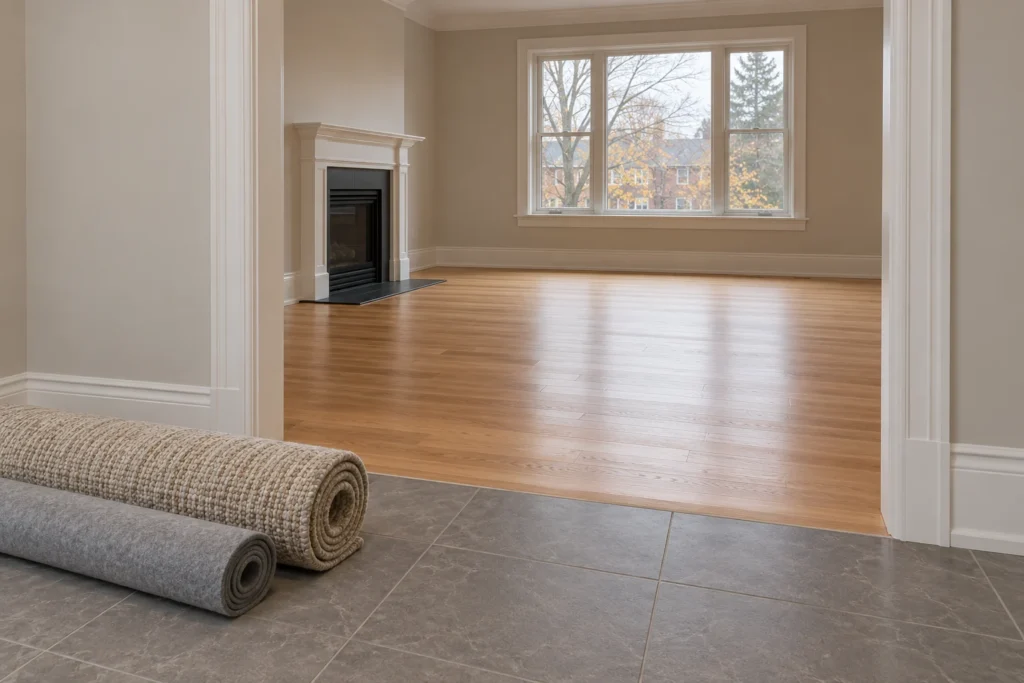
Put rugs back only when the instructions for the finish actually used on your floor permit covering it. A surface that looks dry, or is ready for careful walking, may still need more time before a rug and pad can return. Cold-weather refinishing does not come with one reliable extra waiting period.
For a Toronto or GTA project, ask for a written return-to-use schedule before the final coat goes down. This guide helps you separate the milestones, check a product-specific example and plan the room’s return to normal use. It applies to a finish freshly applied on site, not automatically to factory-finished boards installed without a new coating.
Separate drying, walking, furniture and rugs
“The floor is ready” needs a second question: ready for what? Ask your refinisher to give each activity its own instruction.
| Milestone | What to confirm | What not to assume |
|---|---|---|
| Surface drying | Which drying stage the product instructions describe. | A dry appearance does not establish that the room can be used. |
| Walking | When access is allowed, with what footwear and traffic restrictions. | Permission to walk does not cover moving furniture or laying rugs. |
| Furniture | When each item can return, including heavy pieces and rolling loads. | A small chair and a piano do not create the same moving problem. |
| Rugs and pads | When floor coverings are allowed and whether the backing is compatible. | The rug date cannot be inferred from the walking date. |
Do not test a fresh coating by pressing a fingernail into it, sliding a chair across it or laying down a rug overnight. Use the finish instructions and the contractor’s assessment rather than a test that could mark the surface.
A current product example: Bona Traffic HD
The Bona Traffic HD US technical data sheet, dated May 27, 2026, illustrates why the milestones must stay separate:
- It lists a drying time of 2–3 hours.
- Walking is allowed after 24 hours, with susceptibility to scuffing or marring before full cure.
- Curing takes approximately three days; rugs must wait until the finish is fully cured.
- The application section recommends 65–80°F, approximately 18–27°C, and 40–60% relative humidity. Lower temperatures or higher humidity extend drying.
- Cleaning is dry-only during the first week.
These are instructions for that specific North American product, not every Bona finish or every hardwood floor. The sheet does not provide a separate furniture-return time, so ask the contractor to confirm that rather than borrowing a number from another product. This example also shows why permission to return rugs does not automatically authorize liquid cleaning.
What changes when the weather turns cold?
The outdoor forecast is not a substitute for the conditions inside the work area. Before the job, discuss how the room will be heated and ventilated during application and afterwards. Ask whether the finish manufacturer’s requirements can be maintained throughout that period.
If the heating stops, a door is left open during a move or the room otherwise leaves the agreed conditions, tell the contractor what happened and when. Ask whether the return dates need reassessment. Do not simply add an arbitrary “winter day” or assume the original timetable still applies.
Follow the project’s ventilation and safety instructions. Do not close off required ventilation to keep the room warm, or improvise extra heaters and fans to meet a furniture-delivery deadline. If temperature control and the ventilation plan cannot both be maintained, resolve that with the contractor before using or covering the floor.
Make a return-to-use calendar from the final coat
Have the refinisher complete the following handover before you book movers or arrange to roll out the rug. Use actual dates and times, not just “Friday” or “three days later.”
- Record the finish. Include the full product name and version, plus the current technical data sheet and care instructions. “Water-based polyurethane” is not specific enough.
- Record when the final coat was completed. If another coat is applied later, have the contractor update the schedule.
- Write the first permitted walking time. Include footwear, pet access and any limits on traffic.
- Write the furniture-return instructions. Identify large or difficult items separately and agree on the moving method.
- Write the rug-and-pad return date. Confirm that both the covering restriction and backing compatibility have been addressed.
- Write the first permitted cleaning method. Keep the early-care instructions with the approved cleaner’s name.
For an engineered floor, the earlier decision about whether sanding is suitable is a separate issue. Our guide to refinishing engineered hardwood covers that assessment; this calendar starts after the finish system has been selected.
Check the rug and pad before bringing them back
Keep the rug and pad outside the refinished area while you wait. Check their labels or product information, including the backing material, and ask the finish manufacturer or refinisher whether that combination is suitable. A “hardwood-safe” description on a pad does not establish when it may be used over a fresh coating.
Once covering is permitted, make sure the rug and pad are clean and fully dry. Have the room cleared for placement so furniture does not need to be dragged across the surface. The National Wood Flooring Association recommends protective pads beneath furniture legs; confirm the appropriate protection and moving method for your newly finished floor.
Use the finish-specific early-care instructions rather than immediately returning to the old cleaning routine. For ongoing care, the NWFA recommends a cleaner appropriate to the floor’s finish.
If the rug is already down, do not hide a problem
If a rug was returned early, contact the refinisher with the product name, final-coat time and how long the floor was covered. Explain any tackiness, imprint, unusual sheen or discolouration. If the rug or pad seems stuck, do not pull it off forcefully or try solvents, polish or sanding without advice.
A photograph can help document what you see, but it cannot prove that the coating is fully cured or determine the repair. Keep the area out of use while you obtain product-specific instructions.
Plan the handover as well as the refinishing
When discussing hardwood floor refinishing with LV Flooring, include your furniture, rug and room-access plans. Ask for the finish system and separate return-to-use instructions in writing. That gives you a practical schedule without relying on a universal seven-day rule.
Tag