Does Hardwood Flooring Need Underlayment? Match It to the Installation
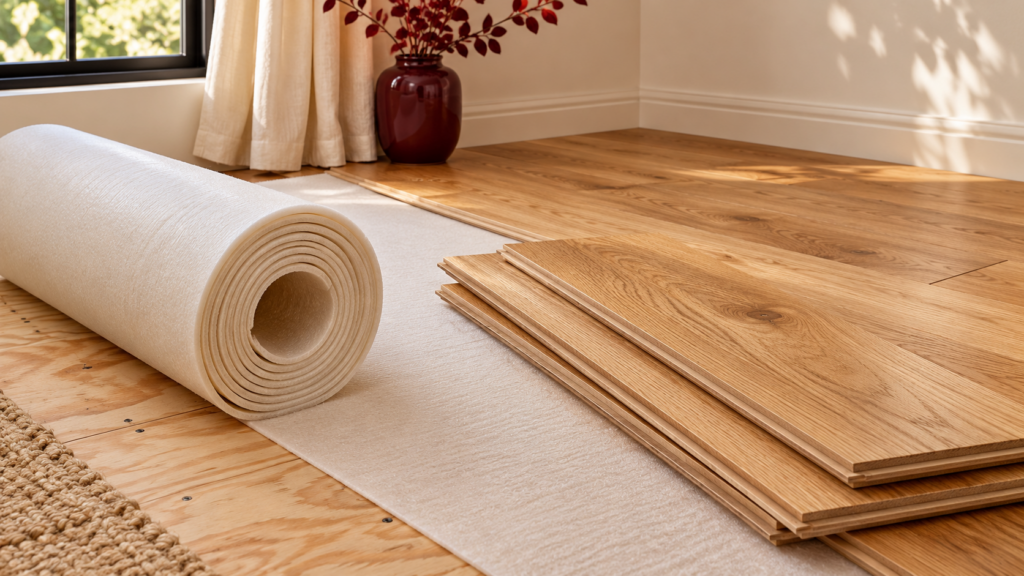
Hardwood flooring does not use one universal underlayment. A floating engineered floor may need an approved resilient pad, while a glue-down floor needs a compatible bonding system. A nail-down installation can have different requirements again. Choose the flooring and installation method first, then specify what belongs underneath.
Start with what “underlayment” means
On a quote, the word can mean a soft roll, a sound-control membrane, or an additional panel layer. Those products do different jobs. A plywood panel helps form a suitable substrate; a thin acoustic pad is not a structural repair. Likewise, sound reduction and moisture control are separate requirements, even when one approved product provides both.
Ask your installer to name the exact material, its purpose and its position in the floor assembly. “Premium underlay included” is not enough information to compare two proposals.
Floating engineered hardwood: use the approved pad
A floating floor connects board to board rather than being fixed across its surface to the subfloor. The underlay is part of that installation system. Its thickness and resistance to compression matter, so the softest or thickest roll is not automatically the best choice.
Do not double up pads to make the floor feel more luxurious. Extra movement can put stress on the joints. If a product has an attached backing, check whether any additional layer is permitted. The installation instructions should also address moisture protection for the substrate.
Glue-down hardwood: preserve the bond
For direct glue-down installation, do not put a loose foam roll between the adhesive and the subfloor. The system needs an approved bonding path. A specialist acoustic membrane may be possible, but the membrane, adhesive and flooring must work together as a specified assembly.
Some adhesives have moisture-control capabilities under defined conditions. That does not mean every adhesive replaces testing or every membrane solves an excessive-moisture problem. Record the substrate test results and match them to the selected system’s limits before work begins.
Nail-down hardwood: follow the fastening specification
A mechanically fastened floor needs an appropriate wood substrate and the correct fasteners. Where a moisture-retarding sheet is required, it is not interchangeable with a cushioned floating-floor underlay. Avoid adding materials simply because they were recommended for laminate or vinyl elsewhere in the house.
Our engineered hardwood installation guide explains the broader preparation and installation sequence. For underlayment selection, keep the focus on the exact board and fastening method.
In a condo, check the whole sound-control assembly
Ask the building for its current flooring requirements before ordering. A prominent acoustic number on a package may come from a test assembly unlike your concrete slab, ceiling and finish combination. Have the installer identify the supporting test information and obtain any required building approval before installation, not after the material arrives.
Five questions to put on the quote
- Which flooring product and installation method are specified?
- What substrate repairs or flattening are included?
- Which underlayment or membrane is proposed, and what does it do?
- How will moisture and any condo acoustic requirements be addressed?
- What finished height will the full assembly create at doors and transitions?
At LV Hardwood Flooring, the useful starting point is your room and floor assembly, not a generic roll of foam. Bring the product details, subfloor information and any condo rules so the materials can be assessed together.
Tag