Condo Hardwood Flooring in Toronto & the GTA: What You Actually Need to Know (2026)
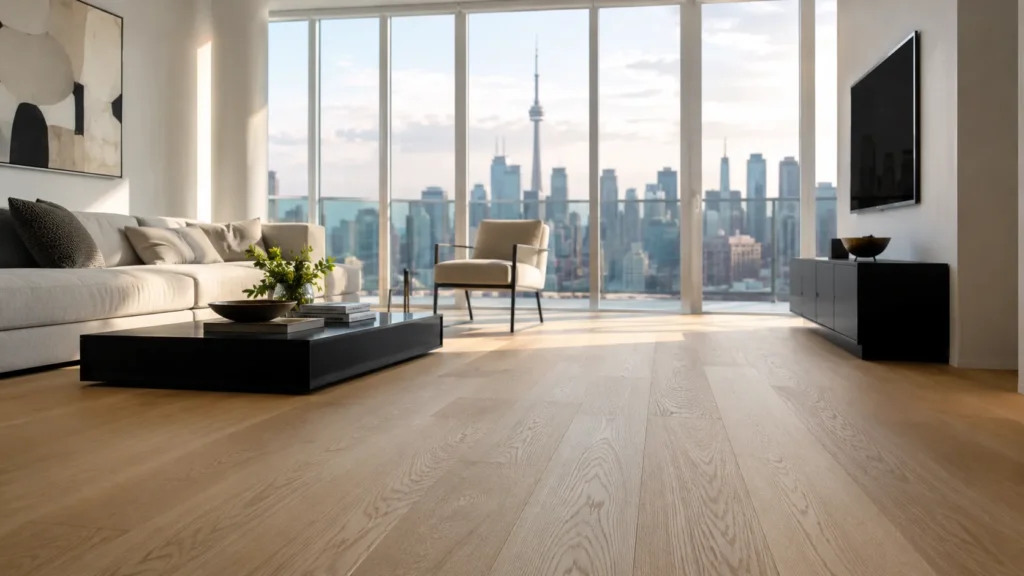
Condos are the trickiest flooring projects we do — not because the installation is harder, but because of everything that happens before the first plank goes down. A detached-home owner picks a floor they like and books us. A condo owner has to think about a concrete slab, a downstairs neighbour, a condo board with a rule book, and a building management office that wants paperwork before anyone touches a floor. After years of installing in towers from CityPlace down to Port Credit, we’ve learned that the flooring is the easy part. This guide walks you through the parts that actually trip people up.
Why concrete changes everything
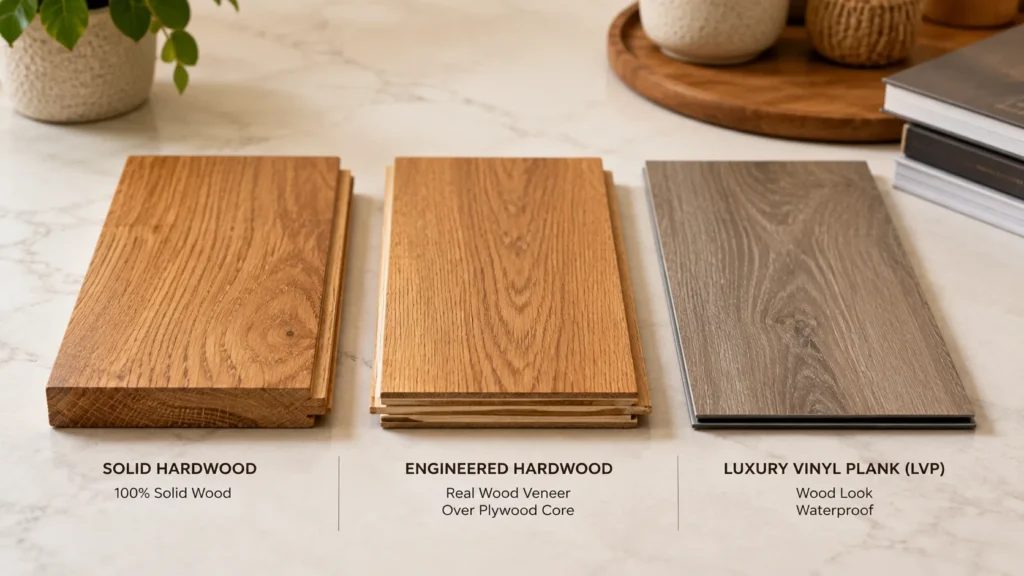
Almost every condo in the GTA is built on a concrete slab, and that single fact rules out a lot of options. Solid hardwood needs to be nailed down into a wood subfloor — you can’t do that on concrete, so solid hardwood is off the table for most units. That leaves two realistic choices: engineered hardwood and luxury vinyl plank (LVP).
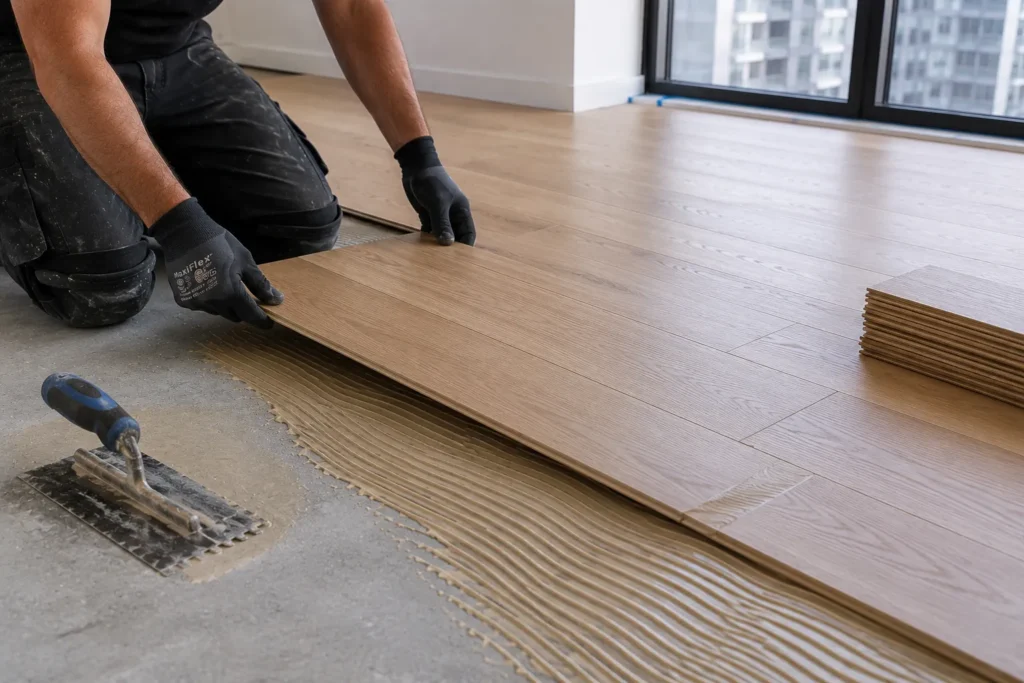
Engineered hardwood is the most popular choice for condos, and for good reason. It has a real wood veneer on top — white oak, red oak, maple — so it looks and feels like solid hardwood, but its layered core stays flat on concrete and handles the humidity swings that come with Toronto’s climate and forced-air HVAC. It can be glued directly to the slab or floated over an underlayment. For a deeper comparison of the two materials in below-grade and slab conditions, our LVP vs. engineered hardwood guide breaks down where each one wins.
The condo board rule you can’t skip: IIC underlayment
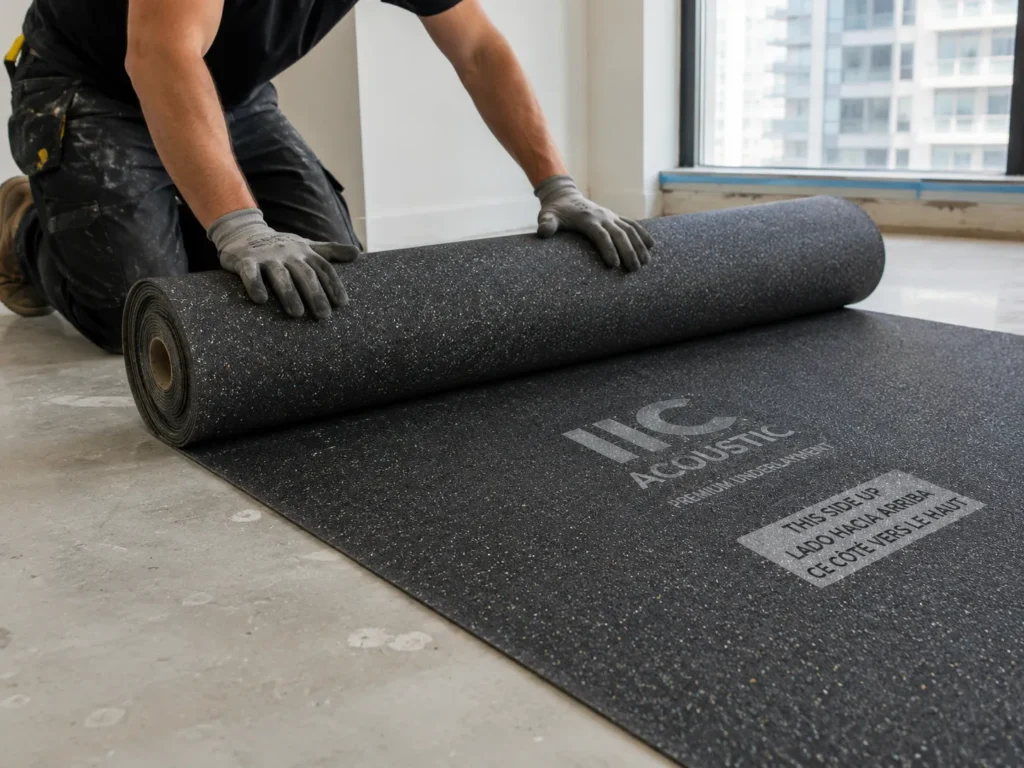
Here’s the requirement that surprises most first-time condo renovators. Nearly every condo board in the GTA has a bylaw about sound transmission between units, and it’s usually written as a minimum IIC (Impact Insulation Class) rating — commonly IIC 50 to 55. In plain terms: your new floor has to include an acoustic underlayment that stops your footsteps from being heard in the unit below.
This isn’t optional and it isn’t something a board overlooks. If you install hardwood without a compliant underlayment and a neighbour complains, the board can require you to tear it out and start over — at your cost. We build the right IIC-rated acoustic underlayment into every condo quote, and we can supply the manufacturer’s acoustic test documentation that most boards ask for.
Before you buy anything: the approval paperwork
Most GTA condo boards require written approval before any flooring work begins. The process is usually straightforward but it takes time, so start it early. Boards typically ask for:
- A completed alteration/renovation request form
- Proof of the flooring’s acoustic (IIC) rating
- Proof of contractor liability insurance and WSIB coverage
- Sometimes a refundable deposit and booking of the service elevator
We’re fully insured and WSIB-covered and can provide those documents directly, which removes the most common reason approvals get delayed. Our advice: submit the package two to three weeks before your target start date. Nothing about the floor itself is slow — the paperwork is.
Which neighbourhoods, which floors
Condo stock across the region isn’t all the same, and it changes what makes sense:
- Downtown Toronto & Yonge corridor (CityPlace, Yonge/Sheppard, City Centre): high-rise units with tight sound bylaws. Engineered white oak with a quality acoustic underlayment is the standard here. Wide plank (5″–7″) reads well in open-concept layouts.
- Mississauga lakeshore & Square One (Port Credit, Lakeview, City Centre): a mix of newer towers and mid-rise. Engineered hardwood and LVP both perform; boards near the lake are often strict on moisture and acoustics.
- North York (Yonge/Sheppard, Bayview Village): dense condo growth around the subway line, concrete slabs throughout — engineered over slab is the norm.
If you want the full picture for your city, our Toronto and Mississauga service-area pages cover local specifics and recent projects.
2026 condo flooring pricing
Condo pricing is driven by the material, the installation method (glue-down vs. floating), and whether the slab needs levelling. As a general 2026 guide:
| Service | Starting from (2026) |
|---|---|
| Engineered hardwood — material | $4–$8 / sq ft |
| Engineered — glue-down install (on slab) | $3–$4 / sq ft |
| Engineered / LVP — floating install | $2–$3 / sq ft |
| Acoustic IIC underlayment | Included in condo quotes |
| Concrete self-levelling (if required) | Assessed on site |
⚠️ Professional Notice: Every condo project is unique. Final pricing depends on slab condition, unit layout, product selected, and your building’s specific requirements. We recommend an in-home assessment for accurate pricing. Contact us for a free quote specific to your unit.
A few things we wish more condo owners knew
Acclimatise the wood. Engineered hardwood should sit in your unit for several days before installation so it adjusts to the space. Rushing this is the #1 cause of gapping later.
Floating vs. glue-down. Floating is faster, less messy, and easy to reverse — good if you may sell or if the board prefers it. Glue-down feels more solid underfoot and is quieter. We recommend based on your slab and how you use the space.
Consider LVP for high-moisture spots. In a unit with a walk-out balcony door or a laundry area, waterproof vinyl plank can be the smarter call for that zone, with engineered hardwood through the main living space.
FAQ
Do I need condo board approval to install hardwood in my unit? In almost all GTA condos, yes. Boards require written approval, proof of the floor’s acoustic rating, and proof of contractor insurance/WSIB before work starts. We provide the documentation and can help you prepare the package.
What underlayment is required for a Toronto condo? Most boards require an acoustic underlayment that meets a minimum IIC rating, commonly IIC 50–55. We include a compliant acoustic underlayment in every condo quote and can supply the manufacturer’s test data.
Can I install hardwood over the concrete slab in my condo? Not solid hardwood — it needs a wood subfloor. Engineered hardwood is designed for concrete and can be glued or floated over the slab, which is why it’s the standard choice for condos.
How long does a condo flooring installation take? Most one-bedroom to two-bedroom units are completed in one to three days once approved, plus the acclimatisation period beforehand. Service-elevator booking can affect scheduling.
Do you serve condos across the GTA? Yes. We install in condos throughout Toronto, North York, Mississauga, Vaughan, Etobicoke and the wider GTA, from our showroom at 5050 Dufferin St #102, North York.
Ready to upgrade your condo floors?
We handle the paperwork, the acoustic requirements, and the install — start to finish. Call (416) 665-5645 or (647) 728-1111, or request a free in-home estimate online.
📍 5050 Dufferin St #102, North York, ON M3H 5T5 🕐 Mon–Fri 9:00–18:00 | Sat 9:30–15:00