Office Chair Wheels or a Mat: How to Protect Hardwood at Your Desk
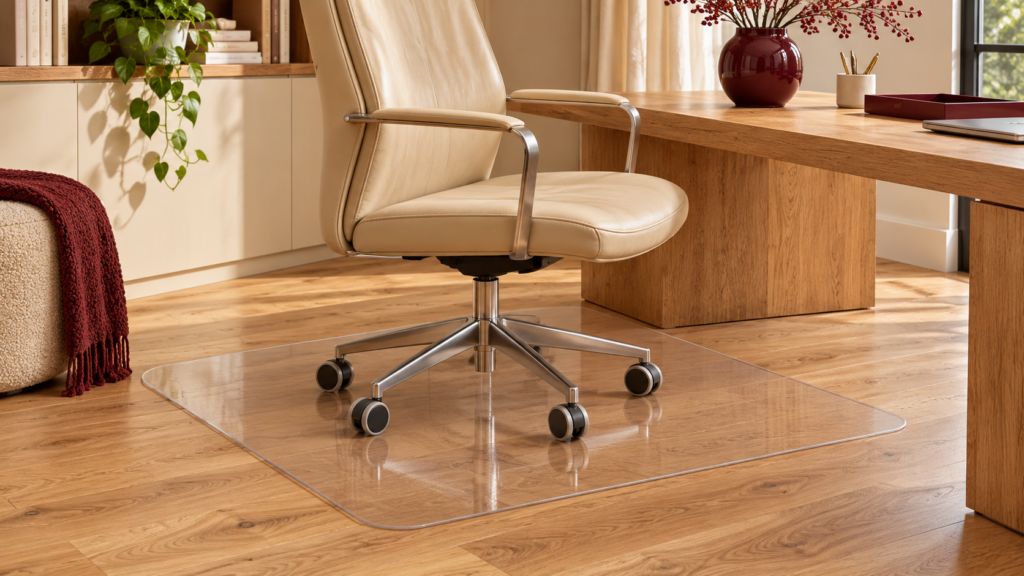
For a busy home office, treat chair wheels and a floor mat as complementary protection rather than competing purchases. Suitable wheels improve the contact between chair and floor. A suitable mat separates repeated rolling from the finish. The right setup also depends on your floor’s care instructions, the chair and how far you move while working.
Start with the chair you already own
Check its manual or ask the supplier whether the fitted castors are intended for hard floors or carpet. Do not judge suitability by colour alone. Replacement wheels must also fit the chair’s stem or mounting system and maintain the chair manufacturer’s load and stability requirements.
Soft castors designed for hard floors can help, but changing the wheels does not make a mat pointless. For intensive rolling traffic, consider a suitable protective mat as well. Check your flooring manufacturer’s care requirements before choosing either.
Choose a mat for the floor, not just the desk
A carpet mat with gripping projections underneath is not the same product as a hard-floor mat. Look for a smooth-backed design specifically intended for the floor surface. Check compatibility with the finish and any underfloor heating, along with the mat maker’s load limits and placement instructions.
Measure your working movement before choosing a size. Sit down, pull back to stand, turn towards a drawer and move into your usual working position. The mat should cover that actual rolling area. A small mat that leaves the rear wheels repeatedly crossing its edge solves only part of the problem.
A simple comparison
- Occasional desk use: first verify wheel and floor compatibility, then decide whether a mat is needed under the applicable care instructions.
- Daily, repeated rolling: consider compatible wheels plus a suitable mat, rather than relying on the wheel label alone.
- A recently refinished floor: get permission to cover it from the finishing contractor before placing a mat.
- A chair that drags or sticks: fix the wheel problem instead of forcing it across the floor.
For fresh finishes, our guide to covering hardwood after refinishing explains why being dry enough to walk on is a different milestone from being ready to cover.
Keep the protection clean
Make the chair area part of your normal floor-care routine. Remove grit around the wheels and check for trapped debris. Lift the mat as its instructions permit and clean beneath it using the method approved for your flooring. Let the surface dry before replacing it.
Inspect the mat’s underside and edges as well as the floor. A protective product that has become dirty, cracked or curled needs attention. The useful question is not whether it was safe when purchased, but whether it remains suitable in daily use.
What if the floor already has marks?
Take a photograph in ordinary room light and another close-up before trying a scratch remover or polish. Check whether the mark is dirt, a surface scuff or actual damage to the finish. Avoid stacking cleaning products in an attempt to make it disappear; keep a record of anything already applied.
If repeated rolling has visibly worn the finish, ask about the appropriate repair rather than assuming the entire room needs replacement. Contact LV Flooring with the flooring details, the chair setup and clear photographs. A good desk arrangement should protect the floor while remaining comfortable to use every day.
Tag